The Holiday Speech

The speechJust last week, I attended the annual Holiday Party of the company from which I  recently retired.  You know, those events that we used to call Christmas parties.  Well, it wasn’t technically a holiday party and it was renamed, simply, a Celebration of 2012.  Oh well, get over it, right?

Anyway, I was asked to be the featured speaker and come up with some interesting commentary about the key issues of the day and how they may relate to our daily lives and deliver it in such a way that would pique the interests of the over 300 attendees that consisted of the entire spectrum of of ethnic and socioeconomic backgrounds, ranging from business owners to tractor drivers.  I guess because I’m a blogger now, some people think I should be smart enough to pull this off.

Well I was all ready to give it a try on that Friday evening, December 14th.  However, a crisis of biblical proportions occurred in a small town in Connecticut earlier that day with the horrific massacre of 20 innocent children and six other adults. Somehow, I felt that anything that I had to say would be rather hollow and insignificant, given the circumstances of the day.  So instead, I decided to switch gears and said a few words centered around the importance of family.  I guess it went off OK, considering I was uncharacteristically unprepared. I managed to get an internet connection on my phone and read from one of my earlier blog posts of nearly two years ago which was entitled, “An Open Letter to my Great Grandchildren”.  A link to that post is HERE. I think that resonated pretty well.

So, for anyone that may be interested in the original speech that went unsaid that fateful night, I have decided to reproduce the text in the paragraphs that follow.

The Speech

Let’s start with the headlines regarding the “fiscal cliff.”  Without a resolution before the end of the year, drastic automatic changes will be take effect that will increase revenue and decrease spending. Another dimension to the cliff issue is the debt ceiling which will cap out in early 2013.  Without an increase, the ability of the government to finance any further deficit spending would be sharply curtailed. Incidentally, our national debt is currently around $16.4 Trillion, but more on that later.

So, in a nutshell, here is what happens January 1 without a resolution:

  • The Bush Tax Cuts will expire on December 31, 2012, the effect of which, will raise income tax rates for everyone.  The Top tier will fo from 35 to 39.6 percent.  Capital gains rates and dividend rates will go up as well.
  • The Social Security payroll tax holiday will expire on December 31, raising the rate from 4.2 percent to 6.2 percent.
  • To fund “The Affordable Care Act” under Obama-Care, tax rates will increase on high-income earners and there will be an additional tax of 3.8 percent imposed on investment income, ie., dividends, interest income, and capital gains.
  • Half of the scheduled spending cuts will come directly from the national defense budget.
  • The eligibility to begin receiving federal unemployment benefits, last extended in February will expire at years end.
  • Referred to as the “Medicare Doc Fix”, the rates at which Medicare pays physicians will decrease nearly 30 percent on December 31st.

The most likely outcome of this current fiscal dilemma will be one of a series of short term fixes that, as they say in Washington, “kicks the can down the road.”  However, as I see it, the real fiscal cliff is the continued deficit spending and the mushrooming national debt.

As I noted earlier, the current national debt is over $16 trillion. This is just the funded portion — the unfunded liabilities of the Treasury, such as Social Security, Medicare and student loans, make it much larger. The recent era of fiscal irresponsibility has thrown an additional $1 trillion or more on the pile every year.  That is what we call the deficit. To fund the deficit, the Treasury sells notes and bonds.  The biggest buyer of these debt instruments is not China or Japan.  It is actually the Federal Reserve.  The Federal Reserve has bought more than 70% of new Treasury debt issued this year.  How do they do that?  In simple terms, they do the equivalent of actually printing new money.  Under normal circumstances that practice would spark rampant inflation.  The fact that it hasn’t  suggests that maybe our dollar is actually undervalued, at least in relation to other world currencies.

The only reason that this staggering debt load hasn’t crushed us is that the Treasury has been able to service it through historically low interest rates (well below 2 percent). These easy terms keep debt-service payments under $300 billion per year, or around 9% of total revenues.

At the current trajectory, the national debt likely will hit $20 trillion in a few years. If, by that time, interest rates return to 5 percent (a low rate by postwar standards) interest payments on the debt could run around $1 trillion per year. This sum would represent almost 40 percent of total current federal revenues and likely would constitute the single largest line item in the federal budget – more than current defense spending, and more than the current combined outlays for social security and medicare.

While all of this may sound like a doomsday scenario, it really doesn’t have to be.  For over 200 years the American economy has demonstrated remarkable resilience in its ability to bounce back from seemingly insurmountable problems.  There have even been some creative suggestions on reducing the debt.  In particular, I like the one from Ron Paul where he suggests that the Federal Reserve just destroy the notes and bonds on its balance sheet. If done today, that would eliminate $4 Trillion of the $16 Trillion debt. The money that was created to purchase the debt is already in circulation so it shouldn’t be inflationary. Interesting proposal!

So, if you think this recent economic downturn is the worst since World War II, chances are you weren’t born or working during the downturns of the 1970’s and early 80’s.

I started my career in the produce business  in 1973 at an annual salary of $9000 and all the bananas I could eat.  While the 9 year war in Vietnam finally wound down that year, Syria and Egypt attacked Israel and there was talk of Armageddon. We had the Arab oil embargo and gas lines. We invented a new term for our financial misery and it was called stagflation, which was short for a stagnant economy coupled with high inflation.  This was also the decade of the “rope-a-dope” economy, a phrase made popular by Mohammed Ali’s defeat of George Foreman in the 1974 title bout called “the rumble in the jungle.” Unemployment peaked at 8.5% and inflation ran as high as 14%. By the end of the 70’s decade, the rate on a 30-year fixed mortgage was 18%.  And to top it all off, we were all running around wearing Leisure Suits and Bell Bottoms.  Of course that was also the era of the hot pants and that wasn’t too bad.

We finally came to our senses in the early 80’s and things gradually improved. We threw out the rope-a-dope strategy, and came out swinging.  Conditions improved for many segments of the economy in late 1983 and by early 1984, the economy rebounded and the United States entered one of the longest periods of sustained economic growth since World War II. Consumer spending increased in response to the federal tax cut. The stock market climbed as it reflected the optimistic buying spree. Over a five-year period following the start of the recovery, GNP grew at an annual rate of 4.2 percent. The annual inflation rate remained between 2 and 5 percent from 1983 to 1987 — the lowest level in decades.

Looking ahead, of the major catalysts that I see contributing to economic growth in the decade ahead, none is more exciting or holds more potential than our domestic energy boom.  All indications point to the United States becoming a net energy exporter by 2025 thanks to a surge in oil and gas production and dramatic improvements in energy efficiency.  The process known as hydraulic fracturing and horizontal drilling are unlocking massive deposits of oil and gas trapped in shale formations throughout the country. The International Energy Agency recently forecasted that the United States will become the world’s largest oil producer by around 2020, surpassing Saudi Arabia.

A by-product of increased oil production is natural gas. Natural gas is the cleanest burning fuel available today, and the U.S. is swimming in it. We have enough to last 92 years with current known reserves. Pipelines and storage facilities are being built at a frantic pace to handle this production. Worldwide demand for cleaner energy will lead to an increasing trade in liquefied natural gas which is achieved by cooling it to -165 degrees centigrade. Liquefied natural gas is much denser thus occupying less space making it cost efficient for export by trucks or ships.  Currently, many western European countries are effectively being held hostage by Russia for over 80% of their Nat Gas needs which is delivered to them via pipelines.

Also, contributing to our recovery will be the resurgence of American manufacturing.  Just recently, Apple Computer announced that they will produce Mac computers in the U.S. next year and are spending $100 Million to shift production of the line from China. Speaking of Apple Computer…

In the past 12 months, the 20,000 or so middle market manufacturing firms in the United States grew sales by more than six percent — in total that’s around $48 billion of new revenues — and added around a quarter of a million jobs. The manufacturing middle grew more than three times as fast as the broader U.S. economy over the same period, and grew faster even than the developing economies like Brazil, India and Russia that we hear so much about.

Expanding exports and bringing manufacturing home will be essential to rebuilding our economy.  However, the overhang of our expanding debt won’t just disappear on its own.  Most surely, as this debt is monetized, that is, money will either be printed or borrowed to pay the interest, the value of the dollar will weaken resulting higher inflation down the road, particularly for imported goods.  That is all the more reason for bringing more manufacturing home. The traditional hedges for inflation, namely, commodities, gold, and real estate, look like good bets for the next few years.

Our tax system is the most convoluted in the world.  There is something wrong when companies like Microsoft, Cisco Systems, and Oracle hold a combined sum of $115 Billion overseas compared to just $19 Billion at home.  The 35% corporate tax rate is too high and just serves as a disincentive to putting it back to work at home.  We need to declare a one-time tax holiday and repatriate this cash and make it available for investment in our domestic economy.

As for the personal income tax code, things are even more screwed up. Nearly half of households pay no income taxes at all.  There are valid arguments to replace our current income system with a modified flat tax.  We also need to take a fresh look at limiting deductions and the income limits need to be raised on payroll taxes if we are serious about saving the social security fund.

Out of the $2.6 Trillion collected from all federal taxes in 2011, $1.1 Trillion was from individual income taxes and $900 Million came from Social Security and Payroll taxes.  My suggestion is a modified flat tax of 15/22, where everyone pays 15% on the first $50,000 of income with no deductions, and 22% on all amounts over $50,000, with itemized deductions on that portion capped out at 5% of income. This system would raise over $2 Trillion in revenue and we could eliminate the payroll tax altogether. Believe it or not, I actually worked through these numbers in great detail and sent over an unsolicited detailed proposal to one of the Republican candidates early this year.  Unfortunately, my candidate didn’t make the cut and I seriously doubt that my proposal made it to his desk.
Humbled and Appreciative

retired not expiredYours truly was recently honored with a Lifetime Achievement award from some of my closest friends and associates with whom I have had the pleasure of working with in nearly 40 years in the produce business.  Below is a link to the video that was played at the annual Produce Marketing Association Sunday breakfast.

WJ Industry Tribute

Thanks to everyone that had a part in this special day  Listed below are links to the individual interviews that contributed to putting this event together.  Also special thanks go to Jamie Strachan and Mishalin Modena for their efforts and thoughtful consideration in the orchestration of this production. –wj

Jeff Johnson

Dick Fisher

Kevin Fiori

Mike Davis

Emanuel Lazopoulos

Tom Dimare

Bryce Edmonson

The Debt Effect

debt-equity-balance-25707431Lets talk about debt and how it should play into ones thinking when examining the true value of a stock or company. In a previous post, I have pointed out the need to consider total capitalization (equity + debt) in evaluating a P/E ratio. Here is an analogy that should help clear up these muddy waters.


Suppose I own an apartment complex that generates $60,000 a year in gross rental income. Further, lets assume that my annual operating expenses (maintenance, taxes, insurance, etc.) total $10,000, so my income before taxes, interest, and depreciation (EBITDA) is $50,000. If the prevailing market assigns a multiple of 15 times EBITDA for apartment complexes, then we can generally say that my property’s market value is in the neighborhood of $750,000. Because I have a $500,000 mortgage, my equity in this apartment complex is $250,000.

Now, lets pretend that I convert this enterprise into a corporation and create 1000 shares of stock. So what is each share worth? $75 or $25? If the property was owned free and clear without a mortgage, the logical answer is $75. But if I sell you one share for $75 knowing full well that there is $50 debt associated with it, would you feel that you are getting a good deal? I think it’s clear, that in this scenario, a reasonable value for one share of WJ Apartments, Inc. stock would be $25 and not $75. If you think that $75 is the correct valuation, I would be happy to sell you all 1000 shares and ride off into the sunset with a big smile on my face and a tidy $500,000 profit.

Now lets apply this same logic to publicly traded common stocks. Company ABC is trading at $20 a share and sports a P/E ratio of 10, meaning that its common stock is selling for 10 times its net income of $2 per share. Company XYZ is also trading at $20 a share with net income of $2 per share and an identical P/E ratio of 10. Company ABC is debt free while company XYZ has long term debt equal to $5 per share. Are they really equal in value?

It’s hard to make a convincing argument that both companies are worth the same $20 per share. But that is how most people look at valuation when using P/E ratios as the sole determinate of value. In the above example, the correct adjustment would be to add the $5 in debt to the equity market price of XYZ Company making the Enterprise Value actually $25. Divide $25 by $2 in earnings and the effective multiple of XYZ is actually 12.5 making it clearly overvalued when compared to Company ABC which trades at a debt free multiple of 10.

A corollary to this argument suggests that company XYZ is only worth $15 a share compared to ABC at $20 a share, even though both report net income of $2 per share.

Why Do We Own Stocks?

Stocks_trading_buy-sell-or-holdA lot has been made of the lack of trading volume on the major stock exchanges. The conventional wisdom attributes this phenomena (or lack thereof) to general distrust and fear of the system of late.  It is also well documented that high-frequency computer trades often account for over half of all shares traded in a single session.

So what?  Too much emphasis is placed on daily market price swings of stocks, and not enough on why we should own shares in the first place.  Shares in companies, be they private or publicly traded are merely units of ownership that measure one’s claim to the company’s assets and earnings. Buying and selling stocks and just wishing and hoping based on the “Greater Fool Theory”, (Google it), is just that – a fools game that should be left to the algorithm number crunchers and their super computers.

It is amazing to hear the nonsensical responses to the question, why do you own a particular stock?  You get things like, ”they make cool products”, or “it has split three times” and on and on.  Instead the focus should be on:

  1. Dividend yield and dividend growth
  2. Dividend sustainability (cash flow coverage)
  3. Barriers to entry (moats)
  4. Financial leverage (use of debt)
  5. Return on Invested Capital.
  6. Tax Efficiency

The above is not a complete list but it is a good start.  If one is not willing to address them then they should stick to mutual funds or ETF’s.  I will qualify this statement as an opinion and not necessarily a statement of fact.  Absent from the above list are “share buybacks.”  More often than not, management has proven to be lousy market timers when it comes to buybacks.  However, there are occasions when buybacks make sense, only when the stock becomes extremely undervalued.  Buybacks then remove shares from the weak hands of panic sellers paving the way for to spread future dividend payments over fewer shares thereby increasing the per share yield.

There is little need to expand on points 1, 2 and 3 as they should be self-explanatory. However the complex relationship between points 4 and 5 warrant further discussion. First, there is too much weight placed on a company’s price/earnings ratio as a yardstick of value.  The P/E ratio completely ignores the long term debt on the balance sheet and considers only its common stock capitalization which is calculated by multiplying the current stock price by the shares outstanding divided by the earnings per share. If the common stock is a claim on the company’s earnings and assets, then so is its debt.  Therefore, a more appropriate yardstick of value is the Enterprise Value/Earnings ratio.  Enterprise Value (EV) combines market cap and long term debt reduced by cash and then divided by the net income.

As an example, consider two companies with identical P/E ratios of 10.  Company A has no debt while company B has long term debt equal to 50% of its market cap. Ignoring cash, Company A has an EV/E ratio of 10 while Company B’s EV/E ratio is a much higher 15.  Which company is more valuable?

This is not to say that debt is necessarily bad which brings us to point 5, “Return on Invested Capital (ROIC).”  This may be the most important metric to consider when adding debt to the capital structure to finance growth.  Simply put, if the return on capital is greater than the cost of capital, then debt is good.

And finally Tax Efficiency should be considered in structuring a portfolio.  I refer to this in the context of what classes of investments belong in which accounts.  For instance, conventional blue chip dividend paying stocks are most efficient in a tax deferred account such as an IRA or 401K.  Taxable accounts should be overweight with tax deferred investments such as Master Limited Partnerships (MLP’s) where distributions are essentially return of capital.

Also on the subject of tax efficiency Real Estate Investment Trusts (REITS) and Business Development Companies (BDC’s) have inherent built-in tax efficiencies.  They avoid the double taxation curse of traditional corporations as long as they distribute 90% of their income to their shareholders.  Unlike MLP’s though, the income to the shareholder is not tax deferred.

So, trade away, buy and hold, to each his own. But know why you are doing what you do.

So Much Data – So Little Time

confusing financial termsAs the universe of investment options continues to expand, so too have the metrics available to evaluate them.  Hardly a week goes by without some new sure-fired silver bullet method surfacing that virtually guarantees a bulls-eye hit on the stock selection wheel. Navigating the treacherous waters of common stocks can be a harrowing experience indeed.  Do we seek value, growth, income?  Or should we just buy the shares of a company just because we think the stuff they make is cool?
So much for the metaphors – it’s time to get real.  Two of the traditional and most widely used stock data indicators are the Price/Earnings ratio (P/E) and Return on Equity (ROE).  In their raw and unscrubbed form, both can be misleading when used as guideposts in stock selection and determining the optimum entry and exit points.

The ubiquitous Price Earnings ratio is arrived at by simply dividing the current stock price by the reported earnings per share. The P/E ratio can be expressed as either trailing or projected.  For example, if a stock is trading at $50 per share and the reported or projected earnings per share is $5.00, the Price Earnings ratio is 10 ($50 ÷ $5 = 10). The problem with the P/E as a measure of earnings is that it only uses the market capitalization of the outstanding common stock and ignores Long Term Debt.  The truth of the matter is that common stock and debt are both claims against a company’s assets and should therefore both be considered in the valuation exercise.

For example, if company A and company B are both trading at $50 with earnings of  $5 a share, then they will both sport a P/E ratio of 10.  Since both companies have 10 Million shares outstanding they therefore have equal stock market capitalization of $500 Million.  However, suppose that company A has no long term debt, but company B has $250 Million in LT debt. In this case, the total capitalization of company B (claims against its assets) is $750 Million compared to $500 Million for company A. So when we adjust the Price Earnings ratio of company B to reflect its debt level, it now becomes 15.  The case can now be made that company B is 50% overpriced compared to company A based solely on their ratios of earnings against total capital.

The term that acknowledges the inclusion of long term debt in the capital structure is called Enterprise Value (EV). Enterprise Value is calculated by adding LT debt to market capitalization and deducting cash.  There are several formulas that use EV to measure a stock’s current market price, the most popular of which is the EV/EBITDA (Earnings Before Interest, Taxes, Depreciation, and Amortization) ratio.  But to keep things closer to an apples to apples comparison with the P/E ratio, it is preferable to use the EV/E (Enterprise Value/Earnings) ratio instead. The EV/E, where the “E” represents net income, is most useful when comparing alternative investment choices. It also serves as an effective scrubbing mechanism for the P/E ratio.

Return on Equity (ROE) is a widely used efficiency indicator that measures net income as a percentage of Stockholder’s Equity.  Stockholders Equity is tantamount to book value and is arrived at by deducting liabilities from net assets as listed on the company’s balance sheet.  With the possible exception of banks and pure financial institutions, book value has little to do with the earnings capacity of most businesses. For example, at this writing Google stock is trading at $665 a share, with a book value of $169 a share.  Return on Equity for the trailing twelve months is reported at 20%.  This suggests tremendous operating efficiency but it is almost entirely disconnected from the current share price.

To further illustrate the disconnect, consider The Clorox Company currently trading at $67.50 per share.  Like Google, the Price/Earnings ratio is about 15.  However, Clorox’s book value (Stockholder’s Equity) is a negative $.56 per share and its Return on Equity is a whopping 464%.  Does this make Clorox 20 times more valuable than Google? The answer is a resounding unqualified “no”.

The point is that as average investors looking to buy a few shares of a publicly traded stock, we need to use sensible criteria to support our purchase decisions.  We shouldn’t be overly concerned with decades old book entries that create the distortions noted above. Our major concern should be —  does the current stock price support the earnings performance and potential of the company we wish to acquire and does its future bode well for providing an acceptable return on our investment?

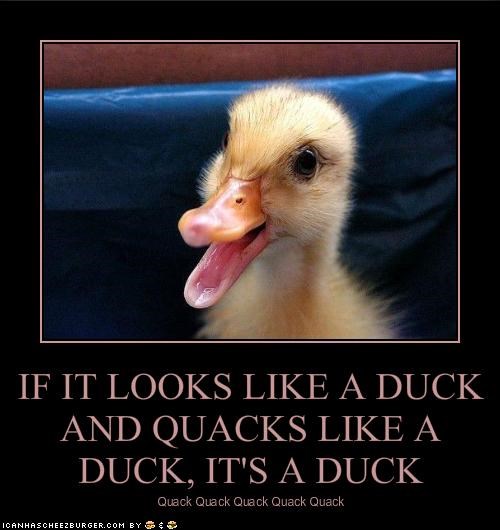
If it Looks Like a Duck…

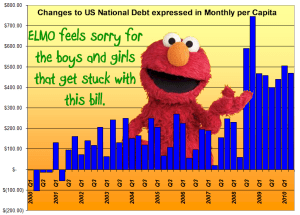
National-Debt-elmoWell it’s been nearly two years now since I started whining and complaining about our national debt on this blog. It all started back in April, 2009 when the tab was $11 Trillion give or take a billion or two. Now its over $14 Trillion, a despicable 27% increase with no signs of abating any time soon.

So what are we to do?  Lots of things, but we can’t tackle them all now. So for starters lets just take a look at the payroll tax.  The payroll tax, aka FICA or social security witholding is currently around 7.5%. By now we all know that this money, originally intended to be set aside to help fund our old age retirements, actually goes into the general fund to help pay for all government expenditures. The surplus in that fund that our leaders delight in referring to is no such thing. It is simply an accounting entry collateralized by IOU’s, aka government notes. So lets face it. It is just a tax – period. And it is the most regressive tax of all. Why? The witholding is only subject to the first $95,000 of your income. If you make under $95,000 your tax rate is 7.5%.  If you make $200,000, your tax rate is 3.5%. Get the picture?

DuckNow that we have determined that your Social Security contributions are indeed just another income tax, what about Social Security payments? Social Security payments are just government welfare. Really! Nothing wrong with that – Pretty soon I will need them, my Mother needs them and millions of other Americans need Social Security benefits to survive.  Problem is, that by 2025, entitlement spending (Social Security, Medicare, et al.) and interest on our debt will exceed projected federal revenue. Can you see how that sucks?

No, I’m not one of those bleeding heart liberal democrats that want to tax the bejesus out of rich people.  The fact of the matter is that I bounce around between Republican and Libertarian values on a pretty regular basis, but on this topic I’m going out on a new limb. If Social Security contributions are a tax and Social Security payments are welfare, then everyone ought to pay the same tax as a percentage of their income. Something on the order of 15% of wage earners make over $100,000 a year. 3% make over $200,000 a year.  If the 7.5% Social Security tax were applied to all earned income, it would easily generate an extra $80 to $100 Billion annually.  Maybe more.

To Be Like Mark

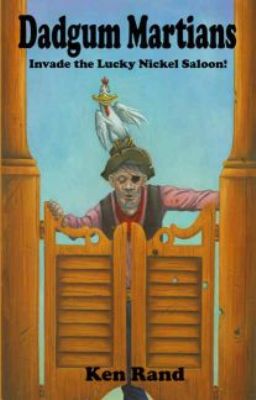
The following is an excerpt from a November, 2006 media interview with Ken Rand on his latest book, Dadgum Martians…

Norilana:

“Whatever in the world gave you the original idea for writing this book?”

Ken Rand:

Since I was a wee tad, I’ve admired the irreverent twangy wit and wisdom of Mark Twain. I’ve always wanted to be Mark Twain, or at least compared to him.” 

On April 21, 1910, author Samuel Langhorne Clemens, better known as Mark Twain, died in Redding, Conn.

On April 21, 2009, author Ken Rand (also known to me as Kenny Whitmore) died in West Jordan, Utah.

RIP Kenny. You made him proud. –wj

The Wonder Years

Who could forget the popular television show, “The Wonder Years” starring the young Fred Savage. The show chronicled everyday life of the fictional Kevin Arnold growing up in the 60’s and his on again off again love affair with Winnie Cooper.

For me, the wonder years were 1955 to 1960. In the summer of 1955, our family, which then consisted of myself, my mom, and three younger sisters moved to a little town located on the Suisun Bay about 30 miles northeast of San Francisco. The town was called Port Chicago. I was nine years old. We were dirt poor but fortunate to have a mother that hung in there, determined to make a life for her four kids.

Port Chicago had a population of less than 2000 and was famous, or should I say infamous, for the worst state-side disaster of World War II. In July of 1944, 320 sailors were killed in an accidental explosion that history would dub as the Port Chicago Mutiny. The collateral damage from the blast was massive and its effects were felt for several miles. The event has been the subject of several books and media accounts over the years, and there was even a movie made about it.

But here comes the real story. Last week I rolled out of bed at my usual time of 5:00 AM or so. It was April 15, tax day. Like many in this e-culture of ours, I get most of my news online and that morning was no exception. For some reason though, I got sidetracked, and started thinking about my childhood days in Port Chicago, and the kids that I ran with during those formative pre-teen wonder years.

So I hit the Google trail and came upon a book review on Amazon.com entitled “Port Chicago –Images of America”, written by Dean L. McLeod. This find turned out to be a treasure chest of old photos of my adopted home town. One of the photos pictured a Naval Memorial erected at the site of the explosion in memory of the victims that died in that 1944 disaster. Flanking the monument in the photo were two people – a park ranger and a Port Chicago native named Ken Rand.

Ken Rand was his real name, but I knew him as Kenny Whitmore. Kenny Whitmore was my best friend during my Wonder Years in Port Chicago. He went by Whitmore then, because, like myself, he was the product of a broken home and for some reason it was decided that it would be better to use the same last name as his mother and new stepfather to avoid confusion. Little did I know that he would eventually reclaim his birth surname in adulthood, which explains why I was never able to uncover any trace of him during my searches over the last 50 years. You see, I was looking for Kenny Whitmore, not Ken Rand.

As it turns out, Ken Rand became a successful journalist, relocating to Wyoming and later Utah. In between real jobs, he wrote over a dozen books and countless short stories, creating his own original genre in the process which I would describe as a humoristic blend of science fiction and the Twilight Zone, against a backdrop of the old west. Go figure! But that’s what I would expect from the Kenny Whitmore that I knew.

Among his writings were three serious documentaries about Port Chicago, the most notable being “Port Chicago Isn’t There Anymore – But We Still Call It Home”. In his Introduction, he describes the life and times of the people in this little rural community by the bay. Unfortunately, none of these books ever hit the NY Times best seller list due to the limited pool of patrons that would care much about this little town with the funny name. But for Kenny, I’m sure it was a labor of love and I’m sure he felt that someone had to do it, and why not him?

I was elated with my discovery. I found his Blog and perused his online book store. I spent the next two hours reading excerpts from his books and short stories. Already an hour past the time when I should have been heading to the office, I fired off an email to him in hopes of getting an answer and rekindling a relationship that had come to an abrupt halt in 1960 when I moved away from Port Chicago.

That afternoon, I received a reply to my email. It was from his daughter, Molly. In her own words, this is what she said…

Dear Woody,

This is Ken Rand’s daughter, Molly. Dad is dying from a very rare intestinal cancer. He will pass possibly this week. He’s glad to hear from you. Please take care and thank you for getting in touch with him.

Sincerely,

Molly Rand Wyatt

Needless to say I was overcome with a mixture of grief, emotion, and wonderment. Why did I pick this particular morning to so aggressively seek out an old friend, an act that I had virtually neglected for the past 50 years? And to think this effort occurred during what could possibly be the last week of his life, makes the action even more remarkable.

I exchanged a couple more emails with Molly that day, one of which I recalled some details of our boyhood adventures. In Molly’s reply she said she read this to her Dad, and he smiled. I guess I was hoping that in some small way that I could bring some spiritual comfort to Kenny and his family by the mere fact that a friend from a half century ago suddenly emerged out of nowhere with a seemingly unexplainable need to make contact with him. And so it went. That was my day on Wednesday, April 15, 2009. It was Tax Day.

And finally, there is this inscription that appears on the July 30, 1988 memorial to those that died in the Vietnam War…

“To the people of Port Chicago:

Port Chicago’s gone forever more.

Things will never be the way they were before.

But people who pass through it say to people who knew it.

What a pretty little town it must have been” – Tom Gott, 1969

A History of Port Chicago

What is Money??

What is Money? Actually, money is whatever the government says it is. How does that make you feel? There was a time when a dollar bill was actually a warehouse receipt for 1/20th of an ounce of gold. World War I and the need for world governments to finance all its catastrophic events was the beginning of the end of a stable asset backed monetary system, and marked the beginning of fluctuating fiat currencies.

Featured imageIn 1934 the dollar was devalued from 1/20th of an ounce of gold to 1/35th of an ounce. To average Americans this conversion right was a hollow promise as ordinary citizens were prohibited from owning gold. Paper currency could only be converted to gold by foreign governments and central banks, which ultimately caused a drain on our gold bullion reserves. Governments, including ours, began pyramiding paper currencies on top of gold, causing further inflation and never stopped. Finally in 1971 we abandoned the last traces to the gold standard and here we are. For what it’s worth, the value of a dollar is now calculated at about 1/900th of an ounce of gold at today’s spot market.

This post isn’t about a return to the Gold standard, although I must admit I have been harboring a fantasy theory about how that could be done which I’m saving for “When I Paint My Masterpiece” [circa 1971, Bob Dylan]. This is actually my first ever recommendation on how to preserve the purchasing value of a dollar using commodities as the cornerstone of this strategy.

So again, what is money? Money is a medium of exchange for the things we need and buy. Our most basic needs are food, energy, and shelter. So what would be a better proxy for money than an instrument that actually tracks and owns the basic items that we need for everyday life. Well there is one and it is an ETF (Exchange Traded Fund) with the symbol DBC. This is a commodity index tracking fund that invests in six future contracts in the following commodities:

1. Crude Oil [34%]

2. Heating Oil [17%]

3. Aluminum [11%]

4. Corn [13%]

5. Wheat [14%]

6. Gold [17%]

Gold is included in the above list, because it is still the one commodity that is universally accepted, easily divisible, and homogeneous in nature. Commodity prices may rise and fall due to fluctuations in supply and demand, but remember their values are always expressed in DOLLAR terms. Unless you have been living under a rock lately, you are aware we are in an unprecedented period of money supply expansion and it looks like it will continue. The inevitable result of this will be hyper-inflation meaning it will take substantially more dollars to buy the commodities we need to exist.